
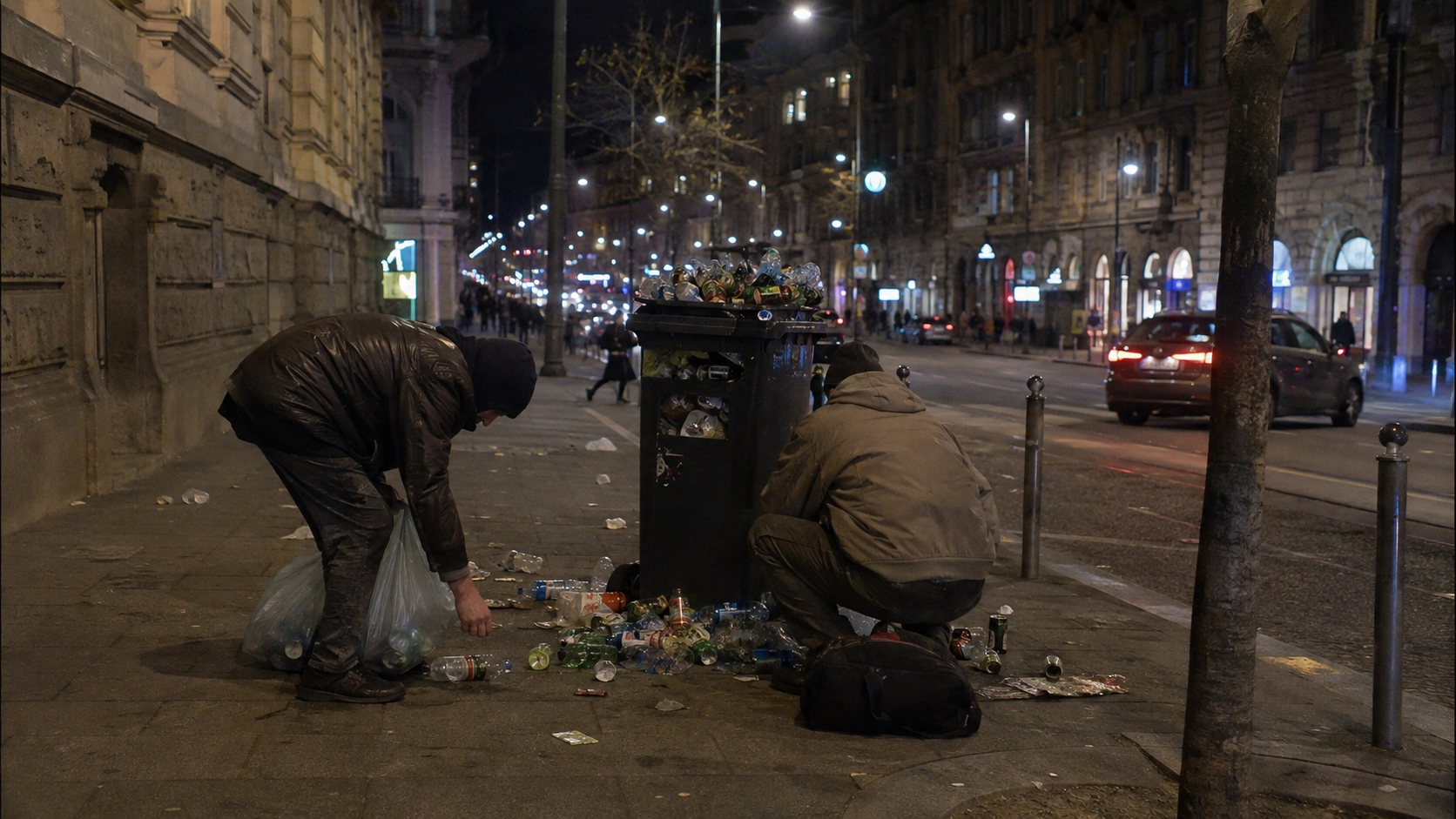
A peculiar nighttime economy has emerged in Budapest’s inner districts since Hungary introduced its 50-forint deposit-return system for beverage containers. Once the sun goes down, collectors begin making the rounds of public bins, restaurants and busy nightlife areas in search of refundable bottles and cans. In some locations, informal “territories” have even developed, with serious competition over the most profitable spots.
The basic idea is simple: eligible plastic, metal and glass beverage containers can be returned for 50 forints each.
Fifty forints may not sound like much. But 100 bottles are worth 5,000 forints, while 500 bottles add up to 25,000.
Collectors interviewed by RTL’s Házon kívül programme said that some people can gather bottles worth between 15,000 and 40,000 forints in a single day. At that level, a discarded bottle is no longer simply rubbish. It has become money.
And wherever there is money, competition eventually follows.
Downtown Budapest is particularly attractive territory. Tourists, restaurants, bars and nightlife venues are concentrated in a relatively small area, producing large quantities of refundable containers every evening.
Collectors quickly learn which streets are worth visiting and at what time.
But this new informal economy comes at a price.
Public waste bins are often searched through or completely emptied while collectors look for refundable containers. The bottles disappear, but the worthless rubbish is frequently left scattered across pavements and streets.
In Terézváros, Budapest’s 6th district, the problem has become serious enough for the local authority to operate a special nighttime cleaning team three nights a week to clear up the mess left around rummaged-through bins.
Yet the basic idea behind the deposit system is not a bad one.
In fact, it has achieved exactly what an economic incentive is supposed to achieve: it has given value to something that was previously simply thrown away.
If a bottle is worth 50 forints, there is a much smaller chance that it will remain lying in a street, ditch or park for long.
The real problem is that the financial incentive has not everywhere been matched by an urban collection system that prevents ordinary rubbish bins from being torn apart in search of refundable containers.
This has created a strange contradiction.
From an environmental perspective, the system can be considered successful because huge numbers of beverage containers are returned for recycling. From an urban-management perspective, however, it has created a new problem: an informal bottle economy complete with routes, territories and competition.
The solution is probably not to abolish the 50-forint deposit.
A better approach would be to make sure refundable bottles do not have to be dug out of ordinary rubbish in the first place.
Separate street collection points, easily accessible bottle holders, more return machines or dedicated containers next to public bins could prevent many of these conflicts.
Because at the moment, we have arrived at a rather strange situation.
We created a system designed to keep bottles out of the rubbish.
Now people are emptying the rubbish because there are bottles inside it.
The so-called 50-forint “bottle war” therefore does not necessarily prove that the original idea was wrong.
It shows instead that when a financial incentive works this well, sometimes the city itself has to adapt to it.