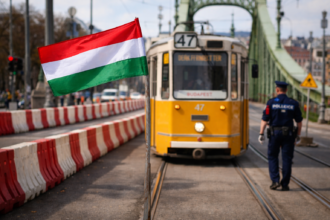


Hungary’s recent parliamentary election has marked a significant political moment, shaped by high voter turnout, strong campaign narratives, and a clear demand for change from a broad segment of the electorate.
In the final days leading up to the vote, political tensions intensified as both the governing side and its challengers mobilized their supporters. Campaign messaging focused heavily on stability versus change, with each side presenting sharply contrasting visions for the country’s future.
Record-Level Participation Signals Public Engagement
One of the most striking aspects of the election was the high level of voter participation. Turnout approached record levels, indicating that the electorate viewed this vote as more than routine—it was perceived as a decisive moment.
High turnout typically reflects not only strong party mobilization but also the activation of previously passive or undecided voters. This suggests that broader societal concerns played a role in shaping the outcome, beyond traditional party loyalties.
Competing Narratives: Stability vs. Renewal
Throughout the campaign, the governing party emphasized continuity, economic stability, and national sovereignty. Its messaging focused on preserving existing policies and warning against uncertainty.
In contrast, the opposition—led by the Tisza Party—framed the election as an opportunity for renewal. Their campaign centered on institutional reform, improved relations with European partners, and a shift in political tone.
This divergence created a clear choice for voters, turning the election into a referendum-like decision on the country’s direction.
The Outcome and Its Implications
The results point to a substantial political shift. The Tisza Party’s performance reflects a consolidation of opposition-leaning voters, many of whom had previously been divided among multiple parties.
This consolidation appears to have been a key factor in overcoming structural disadvantages that had shaped earlier elections.
While the governing party maintained a stable core support base, it was not sufficient to counterbalance the surge of new and re-engaged voters.
International and Regional Context
The election outcome has also drawn attention internationally. European partners are closely watching how the new political leadership will approach key issues, including rule-of-law concerns, EU funding negotiations, and regional security.
Ukraine, in particular, has signaled openness to renewed dialogue, suggesting that bilateral relations may enter a new phase.
However, expectations remain cautious. Any shift in foreign policy will need to balance domestic political realities with international commitments.
What Comes Next?
The coming weeks will determine whether campaign promises translate into concrete policy changes. Key areas to watch include:
- institutional and legal reforms
- economic policy adjustments
- Hungary’s positioning within the European Union
The challenge for the incoming leadership will be maintaining the broad coalition of voters that enabled its success while navigating complex political and economic constraints.
Conclusion
Hungary’s latest election underscores a fundamental principle of democratic systems: political landscapes can change when voter engagement reaches critical levels.
Whether this moment represents a lasting transformation or a temporary shift will depend on how effectively the new leadership manages expectations and delivers on its commitments.
For now, one thing is clear: the electorate has spoken—and its message is being closely examined both at home and abroad.